

Your AI Assistant Is About to Start Selling to You
OpenAI announced conversation-based ads in ChatGPT. Here's what what you need to know about protecting yourself.
On January 16, 2026, OpenAI announced it will begin testing advertisements inside ChatGPT. These are ads that appear based on what you’re discussing with the AI. (source)
If you ask about planning a vacation, expect travel ads. Mention a health concern, and pharmaceutical companies are paying attention. The feature is rolling out to free users and the $8/month “Go” tier in the coming weeks.
Here’s what makes this different from every other ad platform you’ve encountered:
ChatGPT doesn’t just know what you clicked or what page you visited. It knows why. It knows your doubts, your questions, your vulnerabilities. It knows the context that led you to search for something, not just the search itself.
As one privacy commentator put it, “prompts inside ChatGPT can reveal intent, uncertainty, and vulnerability in ways that traditional advertising platforms don’t see.” (source)
Reframing Advertising in the AI Era
Conversational AI exploits something fundamental about human psychology, which is we overshare when we think we're having a private conversation. This creates an “intimacy trap” to the disadvantage of the human and the benefit of the AI. This scenario does not exist in the same way for traditional digital advertising.
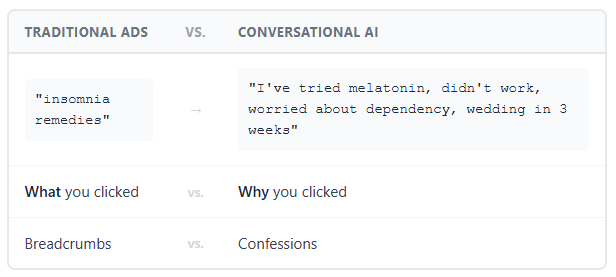
Traditional digital advertising works on breadcrumbs. For example, you visited a shoe website, so shoe ads follow you around. That’s surveillance, but it’s one-dimensional.
Conversational AI advertising works on confessions. You told ChatGPT you’re struggling with insomnia and asked for natural remedies. You explained your budget constraints and mentioned you’re skeptical of prescription drugs. That’s fundamentality different from the breadcrumb trail type tracking we’re all used to.
Put simply: Google gets the question while ChatGPT gets the story.
Google knows you searched for “insomnia remedies.” ChatGPT knows you’ve tried melatonin, it didn’t work, you’re worried about dependency, and you have a wedding in three weeks.
One is a keyword. The other is a marketing goldmine.
The Rollout Is Already Underway
Internal documents reviewed by The Information in December 2025 revealed OpenAI employees discussing giving sponsored results “preferential treatment” over non-sponsored ones. (source) In one example, a user asking about ibuprofen dosage might see a promoted Advil ad, while actual dosage information gets buried.
Even paying customers aren’t safe from the erosion.
In early December 2025, ChatGPT Pro subscribers (people paying $200/month) started seeing “app suggestions” that looked suspiciously like ads. One user posted on X:
“ChatGPT has started posting ads on Pro accounts. I hope this is just testing/a mistake, else it’s an instant unsubscribe from me.”
OpenAI claims ads won’t influence ChatGPT’s responses and conversations will remain “private from advertisers.” But that sounds like a half-truth to us and legal weasel wording.
While advertisers may not see your specific chats, OpenAI must process your conversation content internally to decide which ads to serve. That means your conversations-including sensitive queries about health, relationships, finances, and personal struggles-are being analyzed, categorized, and used to determine what products to push.
The company has committed over $1.4 trillion to AI infrastructure deals and needs $20 billion in annual revenue to break even. That’s not going to come from the ~2% of users paying for Plus or Pro subscriptions. It’s coming from the 800 million people using the free tier-which makes their conversations the product.
The Creep That’s Coming
Here’s what OpenAI’s PR team and other privacy pros won’t tell you: this is just the beachhead.
OpenAI says ads will be “separate and clearly labeled.” They say personalization is “opt-out.” They say they’ll “never” sell your data to advertisers. Maybe that really is the intent. At least for now.
But look at the financial incentives.
Every major tech company that introduced advertising with restrictions and promises has, over time, loosened those restrictions as revenue pressures mounted. Here are two of the most obvious ones:
Facebook started with “targeted ads based on profile information.” Now they track you across the entire internet.
Google started with text ads next to search results. Now they inject Shopping results directly into your search, often pushing organic results below the fold.
The pattern is always the same:
Start conservative, build dependency, expand gradually, claim it’s what users want.
What makes AI advertising particularly insidious is that conversational data creates something unprecedented: the ability to target emotional states in real-time. Someone asking ChatGPT for help with anxiety isn’t just “interested in mental health products”. They’re likely anxious right now, in this moment, seeking help. The advertising potential isn’t just more precise. It’s predatory by design.
Here’s a prediction:
within 18 months, OpenAI will introduce “helpful suggestions” that blur the line between organic responses and sponsored content. The justification will be user experience: “We’re showing you this product because it genuinely solves your problem.” The reality will be that the product got shown because someone paid for preferential placement.
And here’s the part that should really concern you: every conversation you’ve ever had with ChatGPT is potentially training data for this system. Even if you’re on a paid plan without ads now, those past conversations could be used to build and refine the behavioral models that make conversation-based advertising effective. It’s just a terms of service change away from happening.
Practical Solutions and Counter Measures
People will tell you to “just pay for Plus” or “switch to [Competitor X]” to avoid advertising. That’s a reasonable short term solution, but it does nothing to address the direction things are going.
And the real solution isn’t about avoiding ChatGPT or paying your way out. It’s about fundamentally changing how you interact with AI tools. Below are some things that actually work. One is so simple and effective we’re genuinely surprised it’s not more widely recommended.
