

The Job Interview That Steals Your Face
Fake recruiters are running video interviews to harvest your facial geometry and voice. Here's what they do with it, and how to tell a real interview from a collection operation.

You got a LinkedIn message from a recruiter at a company you’ve heard of. The role is a good fit. They want to schedule a 30-minute video call. The interview goes smoothly.
Only there’s one problem - you never hear back.
What you may not realize (at least until it’s too late) is that the “interview” was the purpose, and the job posting was just a ruse.
A growing category of fraud targets job seekers not for their social security number or credit card info, but for something that can’t be rotated like a password or frozen like a credit card: their face and their voice.
How the Scam Works
Fake recruiters are inviting victims to professional-looking video interviews. The conversation feels normal, but the system is recording facial angles, blinking behavior, and voice samples. That data can later be used to bypass liveness checks and even access financial accounts.
The part that makes this different from a garden-variety phishing attempt is what the data enables.
Banks and fintech platforms have been rolling out biometric authentication (Face ID and voice verification) as a security upgrade. The assumption built into those systems is that your face and voice are yours alone. Fraudsters have found a way to challenge, if not disprove that assumption.
A ready-to-use synthetic identity sells for as little as $15 on criminal marketplaces, and tools to bypass financial institution liveness checks are available for between $10 and $50. The raw material those tools need is high-quality biometric data. A 30-minute video interview, recorded without your knowledge, is an efficient way to collect it.
The Scale Is Already Large
Reports to the FTC about job scams tripled from 2020 to 2024, with reported losses jumping from $90 million to $501 million over the same period. That figure almost certainly undercounts the real total; the FTC has noted that the vast majority of fraud goes unreported. And those numbers predate the current wave of AI-powered interview fraud, which began accelerating in late 2024.
Sumsub’s Q1 2025 research found that deepfake fraud surged by 1,100% year over year in North America. What changed? The tooling got cheap enough and capable enough that fraud operations which required significant technical skill a few years ago are now accessible to anyone who knows where to look.
The downstream effects are already showing up in financial crime data. In April 2025, Hong Kong police dismantled a deepfake scam ring that used AI-generated video and cloned voice attacks to open accounts at HSBC, causing losses exceeding HK $1.5 billion, roughly $193 million.
What Your Face and Voice Are Actually Worth
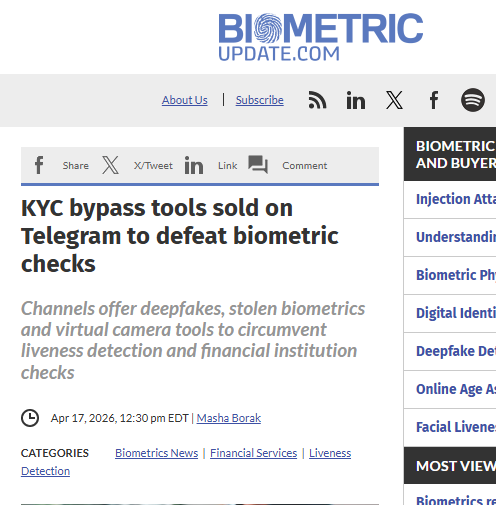
Telegram channels selling stolen biometric data also offer virtual camera tools that can be inserted during liveness checks to substitute a deepfake image for the user’s real face. Sellers even specifically advertise compatibility with major financial institutions including Binance, BBVA, and Revolut.
So the chain looks like this:
fake interview collects your facial geometry and voice samples, that data gets packaged or sold, and it ends up being used to open accounts, approve loans, or transfer funds, all in your name.
Unlike a stolen password, you cannot change your face. Once that data is out, it is out.
Sumsub’s research shows synthetic identity document fraud in North America rose 311% year over year in Q1 2025. Biometric harvesting operations are one of the supply chains feeding that number.
What the Fraudulent Interview Actually Looks Like
Most of these operations put real effort into appearing legitimate. The recruiter’s profile looks credible, often impersonating a real person at a real company. AI-generated headshots and recycled job descriptions make the impersonation hard to catch at a glance.
The interview itself tends to follow normal patterns, focusing on job history, strengths, why you’re interested in the role. That’s partly to keep you engaged long enough to collect usable data, and partly because a functional-sounding conversation produces better audio and more natural facial expressions than an awkward one. The platform will typically be something you haven’t seen before, attributed to a video interviewing tool you can’t find much about online.
My Take
The mainstream privacy conversation is still treating this primarily as an employer problem. In that scenario, companies need to worry about deepfake candidates infiltrating their hiring pipelines. This is a real issue and we’ve touched on it before. But job seekers have been left almost entirely out of the discussion.
The job market for much of the last two years has been brutal enough that people are conditioned to take any interview they can get. Someone in month four of a job search is less likely to run careful due diligence on an interview request, and fraudsters know this (desperation works in a fraudster’s favor).
There’s also a timing problem. By the time you realize a recruiter was fake, the interview recording has already been processed. Most victims never find out at all. They just wonder why they didn’t hear back.
The practical guide job seekers actually need, such as how to vet a recruiter before you accept the interview request, what platform red flags to look for, and what to do if you’ve already participated in something that felt off, doesn’t exist in consumer privacy coverage. That’s what the rest of this post covers.
Vetting a Recruiter Before You Accept
