

The Surprising Hidden Cost of “Free” Budgeting Apps
You might be sharing your transactions with more companies than you think.
Your budgeting app knows you better than your bank.
And when you tap “connect your bank,” you’re often giving a whole chain of companies ongoing access to your transactions, balances, and account details.
Most people never get a clear explanation of what happens next. They just want a clean dashboard and a spending chart that makes sense.
For this guest post we enlisted Vadim Semeniuk, co-founder of Digitus Data (a custom software studio) with over a decade in business. Vadim breaks down the hidden privacy tradeoff behind “free” budgeting apps: the data-sharing ecosystem that sits between you and your bank.
We asked Vadim to write a guest post after checking out his privacy friendly personal finance statement analyzer called SpendSum. This is not an ad and there’s no affiliate relationship. We just thought it was a cool project and wanted to tap into Vadim’s expertise in this area.
In this guest post, you’ll learn what that “connect your bank” button really does, why financial data aggregators matter (even if you’ve never heard of them), and how to do a few high privacy IQ cleanups that make you a harder target.
By the end, you’ll have a simple action plan:
how to audit and disconnect old bank connections
what to look for in a privacy policy before linking accounts
how to tighten up Venmo settings
a couple of safer ways to track spending without handing over your entire financial life.
In March 2024, Intuit shut down Mint.com. Over 20 million people had used the app at its peak. Most of them got a polite email telling them to migrate to Credit Karma, another Intuit product. Same company, same data ecosystem. Most users never thought twice about it and migrated.
What that email didn’t explain was what had already happened to years of their financial data. Or where it went. Or who paid for access to it.
Mint was free. And like most free apps, the product was never the budgeting tool. The product was you.
That was one app. But every budgeting app that asks to “connect your bank” feeds the same machine. If you’ve ever tapped that button, you’re part of it. And chances are you have since a majority of US adults use digital tools to manage their money.
After Mint died, millions moved to Rocket Money, YNAB, Monarch, Copilot. The app changed. The question didn’t:
what happens to your data after you hand it over?
The Company Between You and Your Bank
When a budgeting app asks you to connect your bank account, you’re almost certainly not connecting to your bank directly. You’re going through a financial data aggregator, a company that acts as a middleman between you and your bank.
The biggest is Plaid.
According to Plaid’s own marketing, one in two US adults have connected a financial account through their system. They link to over 12,000 financial institutions and power more than 7,000 apps.
If you’ve used Venmo, Cash App, Robinhood, or Coinbase, you’ve used Plaid. Other major aggregators include Yodlee (sold by Envestnet to private equity firm STG in 2025), MX, and Finicity (acquired by Mastercard in 2020).
Most users have no idea these companies exist, let alone that they’re involved.
Here’s how it used to work (and in many cases still does):
you’d type your bank username and password into what looked like your bank’s login screen. Except it wasn’t. It was Plaid’s interface, designed to mimic your bank. Plaid would then log into your bank as you and scrape your account data. This practice, called screen scraping, was the industry standard for years.
Newer connections use token-based access, which is better. But the core dynamic is the same. A company you never chose now has ongoing access to your transactions, balances, account numbers, income, and investment holdings.
And that access doesn’t necessarily expire when you stop using the app.
Your Spending Data Is More Revealing Than Your Search History
Your search history shows what you’re curious about. Your transaction history shows what you actually do.
A peer-reviewed study published in Psychological Science analyzed spending records from over 2,000 people and found that purchase data alone could predict personality traits like:
neuroticism
extraversion
self-control
materialism.
Open-minded people spent more on flights, extraverts on dining and drinks, the conscientious on savings. All from bank transactions.
But it gets more personal than personality types. Look at what your transactions actually say about you.
A pharmacy charge is a health record. A therapy copay hints at a diagnosis. Donations map your politics and your faith.
Then there’s the stuff you’d rather keep private: gambling app charges, liquor store runs, late-night delivery orders. Splitwise payments and divorce attorney retainers trace your relationships in real time. Payday loans and overdraft fees tell anyone watching that you’re struggling.
Even your daily coffee stop and Tuesday grocery run build a map of your routine. Most people wouldn’t willingly hand that to a stranger.
Researchers at USC and UT Austin analyzed 389 million public Venmo transactions over an eight-year period and found that about 40% of users in the dataset had publicly leaked sensitive information through their transaction notes. Health conditions, political orientation, drug and alcohol use, all sitting in plain text.
No single data source reveals more about a person’s actual life than their spending.
Who’s Making Money Off Your Money Data
It starts with the aggregators.
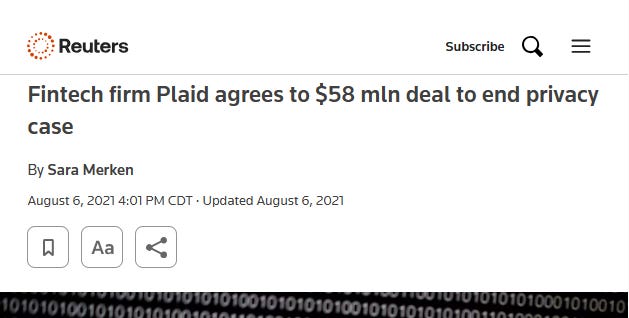
Plaid settled a $58 million class action in 2022 after consumers alleged the company harvested and sold financial data without consent. People who signed up for Venmo didn’t know Plaid was collecting their transaction history, investment data, and salary information. Each affected consumer got about $36.
Yodlee was worse.
Three members of Congress (Senators Wyden and Brown, and Representative Eshoo) demanded the FTC investigate after reports surfaced that Yodlee had been selling bank and credit card transaction data of tens of millions of Americans to investment and research firms. The data showed “how much people spent and where.”
A class action alleged they shared some of this data in unencrypted files. A court later sanctioned them for destroying evidence in a separate case.
Then there are the apps themselves.
Mint’s business model was showing users financial product offers (credit cards, loans, insurance) and collecting referral fees. The catch: the products with the highest fees were rarely the best fit for users.
One analysis noted this “created misaligned incentives between the company and its users.” When Intuit killed Mint, they funneled users toward Credit Karma, a platform with over 130 million members whose entire business is recommending financial products based on your profile.
This is how free budgeting apps stay free. Advertisers pay more to reach someone actively managing debt or saving for a home, and your spending data tells them exactly which bucket you’re in.
Your own bank is in on it too.
JPMorgan Chase launched Chase Media Solutions in 2024, an advertising business that lets brands target Chase customers based on their purchase history. Pilot campaigns with Air Canada, Solo Stove, and Whataburger. The bank charges advertisers only when a customer actually buys something, meaning your past spending directly feeds the algorithm predicting your next purchase.
Mastercard sells access to billions of purchase transactions through more than 25 data service products, according to a US PIRG investigation. Buyers include ad networks, data brokers, insurance companies, and employers.
And all of it feeds a bigger market.
The data brokerage industry is projected to reach $462 billion by 2031 (per Transparency Market Research). Spending data sells for a premium because nothing predicts what someone will do next like what they already spent. Brokers use it to sort people into categories tied to ethnicity, religion, health status, political affiliation, and income level.
This is where a lot of people miss an easy privacy win: it’s not just about limiting new data sharing, it’s also about cleaning up the data that’s already circulating. If you want help with that, DeleteMe is a reputable data broker removal service that can handle opt-outs on your behalf (saving you lots of time). Use this affiliate link to get started and get 20% off.
When the Data Gets Loose
Data that gets collected eventually gets breached.
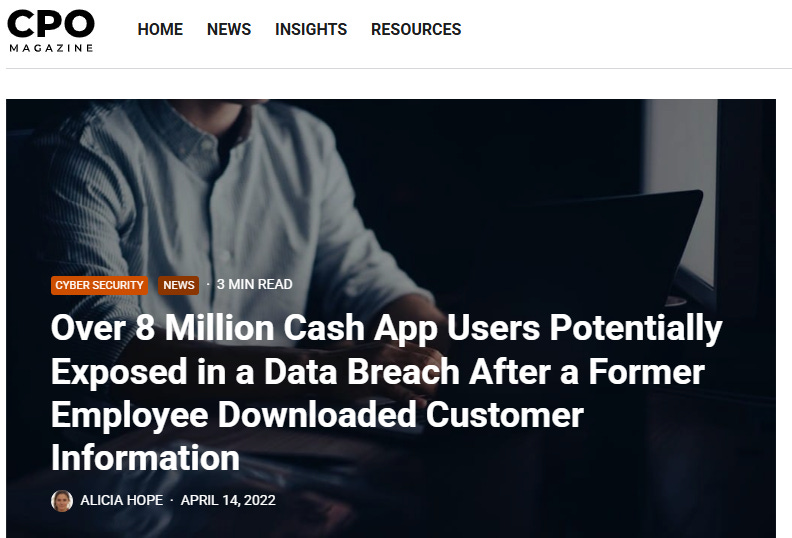
In 2021, a former Cash App employee accessed customer financial reports after leaving the company, exposing the names, brokerage account numbers, and portfolio information of 8.2 million people. That breach led to a $15 million settlement. Separately, Cash App’s parent company Block was hit with an $80 million fine from 48 state regulators in January 2025 for anti-money laundering failures. Two different problems, same company, same customers bearing the risk.
Across fintech, 41.8% of breaches originate from third-party vendors, according to a 2025 SecurityScorecard report analyzing the top 250 fintech companies. Those third parties are often the same aggregators and data processors handling your bank connection.
And then there’s Venmo.
Transactions on Venmo were public by default for years. In 2018, a researcher scraped 207 million public transactions, documenting “users’ lives: everything from cannabis sales to budding romances, to breakups, to how much pizza they ate and how much Coke they bought.”
In March 2025, reporters discovered that National Security Adviser Mike Waltz had a public Venmo friends list with 328 contacts, including White House staffers, military officers, and journalists. The account was only made private after the press reached out to the White House.
Don’t Count on Regulators
If you’re waiting for the government to sort this out, it’s going to be a long wait.
The Biden-era CFPB proposed two rules that could have helped. One (Section 1033) would have given consumers more control over how their financial data gets shared. The other would have treated data brokers as consumer reporting agencies, forcing them to get consent before selling your information.
Both are dead.
A federal judge enjoined the Section 1033 rule in late 2025, and the CFPB is now rewriting it from scratch. The data broker rule was withdrawn entirely in May 2025. The CFPB’s decided it was not necessary or appropriate at this time. (source)
What You Can Do
None of this means you should stop tracking your spending. It means you should care about how you do it.
Audit your bank connections. Start at my.plaid.com. You’ll see every financial account you’ve ever connected through Plaid, often including ones you forgot about years ago. Disconnect anything you’re not actively using. Then check your bank’s own “connected apps” or “data sharing” section and revoke anything stale there too.
Read the privacy policy before connecting. Specifically, search for “data sharing” and “third parties.” If a financial app is free, find out how they make money. That will tell you what’s happening to your data.
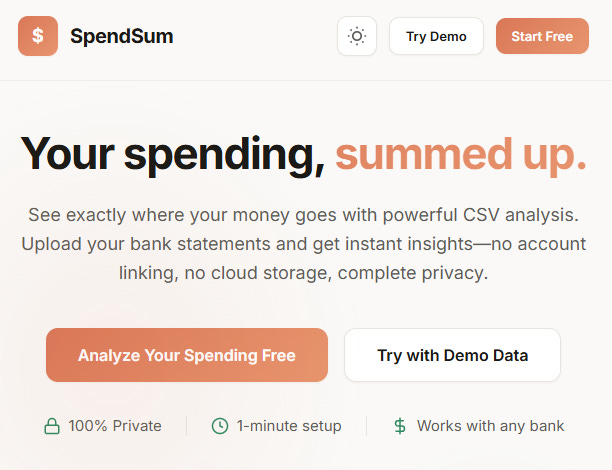
Use tools that don’t require bank access. This is why I built SpendSum, a statement analyzer that runs entirely in your browser. You download a CSV from your bank, drop it in, and the analysis happens on your machine. No bank connections, no accounts, no third-party aggregators touching your data. Nothing leaves your device.
Use your bank’s own tools. Most banks now offer basic spending breakdowns in their apps. Less detailed, but the data stays with your bank.
Lock down Venmo. Switch your default transaction visibility to private (Settings > Privacy > Default Privacy Setting > Private) and review your friends list visibility while you’re there.
Keep transaction notes vague. On any payment app, write “dinner” not “Dr. Martinez copay.” Notes are stored, analyzed, and on Venmo, potentially public.
One Question Worth Asking
Twenty million Mint users got that polite migration email in 2024. Most clicked through to Credit Karma without a second thought. Intuit already had years of their spending data. The cycle just continued with a different app.
Next time an app asks to connect your bank, ask yourself: who else gets to see this data? If you can’t answer that clearly, maybe the app isn’t as free as it looks.
Your spending data is the most detailed record of your daily life that exists anywhere. Treat it that way.
Friendly Ask
If you found this helpful or informative, chances are your friends and family will as well. Please share it with them to help spread awareness.
Looking for help with a privacy issue or privacy concern? Chances are we’ve covered it already or will soon. Follow us on X and LinkedIn for updates on this topic and other internet privacy related topics.
Disclaimer: None of the above is to be deemed legal advice of any kind. These are *opinions* written by a privacy and tech attorney with years of working for, with and against Big Tech and Big Data. And this post is for informational purposes only and is not intended for use in furtherance of any unlawful activity. This post may also contain affiliate links, which means that at no additional cost to you, we earn a commission if you click through and make a purchase.

Privacy freedom is more affordable than you think. We tackle the top Big Tech digital services and price out privacy friendly competitors here. The results may surprise you.
Do you own a Smart TV? If so, you won’t want to miss this post from our three part series on how To make your smart TV less creepy.

If you’re reading this but haven’t yet signed up, join for free (4.4K+ subscribers strong) and get our newsletter delivered to your inbox by subscribing here 👇
Very helpful!
i’m really glad your reporting on this. i see a lot of people seeing things under a really different light.