

They're Testing Censorware on 3D Printers. Your Router Could Be Next.
New York's 3D printer mandate isn't just about ghost guns. It's a legal template for every device you own.
You probably don’t own a 3D printer. Most people don’t.
So it’s understandable if you overlook a new effort by New York State to regulate what you can use a 3D printer for. The problem is this new law would have repercussions far beyond 3d printers.
In fact, it’s another example of legislatures (backed by special interests) using a sympathetic cause to push for a privacy invasion.
What This Law Is Actually Building
New York’s still-unfinished 2026-2027 budget contains a provision requiring every 3D printer sold in the state to ship with mandatory surveillance software. The stated goal is stopping people from printing untraceable “ghost guns” at home. In practice, this means that the 3D printer software will scan every print job against a government-specified algorithm and will refuse to execute anything it flags as a potential firearm component.
Whether that goal is legitimate is a separate conversation. What matters here is the mechanism being built to pursue it:
a government-specified prohibited-content list, embedded inside a consumer device at the manufacturer level, and enforced by criminal law.
It’s worth noting that New York isn’t alone. California and Washington are pursuing identical legislation in the same session. Which implies there’s a centralized push to enact these laws in friendly jurisdictions before wider deployment.
So far, most of the coverage of these bills has stayed inside the 3D printing community, focused on whether the algorithm actually works. That’s the wrong frame and not thinking big picture enough.
The larger concern is what gets established as legally acceptable, and which devices legislators decide to target next. Because the legal precedent set here can easily apply to other commonly owned devices.
What the Algorithm Actually Has to Do
A brief overview of 3D printer technology is helpful here to understand why 3D printers are the initial target.
3D printers work by following a script that includes thousands or even millions of tiny instructions that say things like “move left 2mm, extrude a little plastic, move right 3mm.” The printer executes these one by one, in order, with no idea what it’s making. It doesn’t know if it’s building a chess piece or a phone case. It just follows the list.
To comply with a law like the one proposed in New York, manufacturers would have to build software capable of analyzing that code in real time. The software would need to infer the geometry of the object being constructed, and compare it against a prohibited-shapes database. It would stop working if it matched a prohibited design.
Pilot tests found these algorithms triggered on 17% of non-weapon prints due to superficial geometric resemblance to firearm components. Things like L-shaped brackets and cylindrical housings. Basically anything that looks vaguely like a barrel or receiver to software with no ability to understand context.
The algorithm doesn’t work well enough and has a high false positive rate, which is a problem in and of itself. Similar things are happening with the AI technology automobile manufactures will soon be required to deploy in vehicles in the U.S. and EU. The tech doesn’t work well enough to meet the stated goal.
But whether the tech works or not is likely beside the point.
What This Law is Actually Building
The surveillance apparatus required to block the 3D printing of firearm components is comprised of the following:
A database of prohibited designs maintained by the state and updated at the state’s discretion, with no public process for contesting entries
Mandatory firmware on a general-purpose manufacturing device that checks against that database
Class E felony charges for possessing certain design files, even if you never print anything
Criminal penalties for anyone who share those files with anyone the state hasn’t licensed.
The censorware doesn’t even have to work to cause harm. Creating a government-controlled blacklist baked into consumer devices, backed by criminal penalties is the harm. The technology is almost beside the point. The real goal is creating infrastructure to monitor and restrict consumer behavior, and the ghost gun argument is just how they’re selling it.
On the Ghost Gun Rationale
If you’ve read my coverage of age verification laws, the ghost gun rationale will feel familiar. (see here)
“Protect the children” is a political argument that is almost impossible to oppose publicly, which makes it an effective vehicle for pushing through surveillance infrastructure that would face real scrutiny if proposed on its own terms. Nobody wants to be the legislator who voted against protecting kids. The policy that gets attached to that rationale is almost beside the point.
Ghost guns serve the same function here.
“Stop people from printing untraceable weapons at home” is the kind of argument that can move quickly through a legislature, especially when it’s buried in a budget bill rather than debated as standalone policy.
The 3D printing community is fighting it on technical grounds, arguing the algorithm doesn’t work and the false positive rate makes it unworkable. Both things are true.
But a law doesn’t have to achieve its stated purpose to establish a precedent. What matters is what legal architecture gets built in the attempt, and whether that architecture is available for the next application once this one normalizes it.
The “Dual-Use” Problem
“Dual-use” is a term used in military and export-control law, where it describes technologies with both legitimate civilian applications and potential weapons uses.
That term used loosely applies well in the 3D printer regulations context because the underlying logic is the same. Every legislature that passes a version of this 3D printer law is establishing that a consumer device with obvious legitimate uses can be required by statute to run government-specified content-filtering software, enforced at the firmware level. Criminal penalties are available for circumvention.
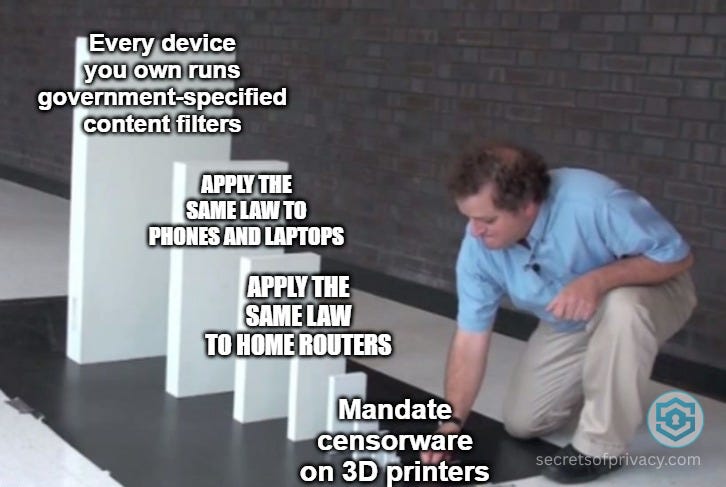
3D printers are the test case. They’re politically convenient because the user base is small and most voters don’t own one. The same statutory structure can be applied to any device a future legislature decides fits the same description.
The 3D printing angle is ultimately a distraction. Here’s what this actually looks like applied to devices you do own.
Routers
Your home router transmits web traffic that could, theoretically, be used to plan violence or coordinate criminal activity. A dual-use designation doesn’t require the device to be primarily used for harm. It requires only a plausible argument that it could be.
Under a router-targeting version of this template, your ISP or router manufacturer could be compelled to run state-specified deep packet inspection firmware, refusing to route traffic flagged by a government algorithm, with criminal liability for anyone who tries to disable it.
Laptop Cameras
Your laptop camera can be used to record things the state might someday want to restrict. So can your phone.
We already have a live version of this debate in the CSAM (child sexual abuse material) scanning context, where governments have pushed Apple and others to implement client-side scanning that checks your photos against a government database before you can upload them. The 3D printer law is that argument applied to manufactured objects rather than digital images.
General Equipment
A document scanner in a law office, a CNC router in a small machine shop, and a laser cutter in a school makerspace are all general-purpose tools that can produce outputs someone in a legislature might someday want to prohibit.
The legal template being built in New York doesn’t care which device it’s applied to. It needs a public-safety rationale, a device class the public doesn’t feel strongly about, and a state legislature willing to bury the provision in a budget bill.
The Manufacturer-Compliance Wrinkle
One thing that gets lost in the “government surveillance” framing is the state doesn’t run this software. Manufacturers do. And they do so under compulsion from the state, which is effectively getting the manufacturer to do their surveillance dirty work.
This is a feature, not a bug.
It gives the state the surveillance outcome without the accountability that would attach to a government-run program. The manufacturer takes the legal and reputational exposure. The state gets the compliance. Users get a device that reports their activity to a third party under terms they can’t negotiate, enforced by criminal law.
Where This Stands
New York’s budget is still being negotiated, and this provision could be stripped in conference. California’s AB 2047 and Washington’s HB 2321 are still moving. If any of these pass, the others get easier.
A passed law is a model. Legislators who want to look tough on ghost guns will cite the precedent, and manufacturers who’ve already built compliance infrastructure for one state will lobby for uniformity rather than a patchwork.
The 3D printing community is fighting this on technical grounds. Those arguments are correct. They’re also arguments about a narrow constituency. The precedent being set here goes far beyond 3D printing.
Looking for help with a privacy issue or privacy concern? Chances are we’ve covered it already or will soon. Follow us on X and LinkedIn for updates on this topic and other internet privacy related topics.
Disclaimer: None of the above is to be deemed legal advice of any kind. These are *opinions* written by a privacy and tech attorney with years of working for, with and against Big Tech and Big Data. And this post is for informational purposes only and is not intended for use in furtherance of any unlawful activity. This post may also contain affiliate links, which means that at no additional cost to you, we earn a commission if you click through and make a purchase.
Know your doxxing risk. DoxxScore gives you a personalized exposure assessment and action plan in under 5 minutes. Get Your Risk Score →
Check out our new, free username generator to help you create unique usernames for different accounts. Reusing usernames is convenient, but terrible for your privacy. This tool makes it easy to create unique usernames on the fly.
Lets hope they can be fought and defeated through the court system.
New York also has a law (or will have one soon) to fprce operating systems to perform age verification. "Won't somebody please think of the children!" weaponized by the elites for control. The elites' shared nightmare is losing control.
Guns must be registered.
Ham radio users must register with government, use ID, not allowed to talk politics or geopolitics.
ID required to use the internet (age verification).
Cars have a kill switch.
Printers print hidden identifying marks, refuse to print US dollars.
3D printers run government-mandated malware.