

VPN Bans Are Coming
After chat control and age verification, restricting VPNs is the next step in the online surveillance playbook
If you’ve been following the push for age verification laws in the UK, EU, and across US states, you’ve probably noticed something: every time governments mandate ID checks for websites, VPN usage surges.
And now, predictably, governments are coming for the VPNs.
We wish this was speculation, but it’s not. Legislation is already in the works across the West which will only accelerate in 2026.
But we have a solution you can start working on now to prepare for the eventual restrictions or bans. Keep reading to learn more.
The Three-Step Playbook
Here’s the sequence we’re watching unfold in real time:
Step 1: Chat Control. Governments push for the ability to scan private messages (including encrypted ones) ostensibly to find illegal content. The EU has been fighting over its Child Sexual Abuse Regulation (CSAR) for three years. While the most aggressive versions keep getting blocked, they keep coming back. The Danish EU presidency made it a flagship priority in 2025, and a “voluntary” version was finally approved in November.
Step 2: Age Verification. The UK’s Online Safety Act took effect in July 2025, requiring photo ID, facial scans, or credit card verification to access adult content. Similar laws are now active in 25 US states. Australia banned under-16s from social media entirely.
Step 3: VPN Restrictions. When millions of people used VPNs to bypass these checks, governments noticed. Now they’re moving to close the “loophole.”

What’s Already Happening
United Kingdom: After the Online Safety Act triggered a 6,000+% surge in VPN usage, the House of Lords tabled an amendment to ban children from using VPNs. Under the proposal, VPN providers would have to verify the age of all UK users. The government has said it will “look very closely” at VPN usage. UK MPs are now openly calling for VPNs to be “in scope” of age verification requirements. (source)
Wisconsin: Assembly Bill 105/Senate Bill 130 doesn’t just require age verification, it requires websites to block access from anyone using a VPN. The bill has passed the State Assembly and is moving through the Senate. (source)
Michigan: The proposed “Anti-Corruption of Public Morals Act” goes even further. It would force ISPs to actively block VPN connections and ban the sale of VPN services outright. Proton, the encrypted email provider, called it “a danger for political discourse.” (source)
Denmark: The government proposed banning VPN use to access geo-restricted content. The chairman of the IT Political Association said the bill had a “totalitarian feel to it” and noted that “even in Russia, it is not punishable to bypass illegal websites with a VPN.” The proposal was withdrawn after public backlash. (source)
European Union: The ProtectEU internal security roadmap explicitly mentions VPNs and anonymity services as problems to be “solved.” France and Sweden are debating rules forcing VPN providers to decrypt traffic logs.
What Comes Next: The Licensing Model
Privacy and security experts mock politicians for trying to ban VPNs. These claims essentially boil down to impracticality.
VPNs are fundamental to modern business IT, which makes a “ban” hard to envision. Every corporation with remote workers uses them. Diverse industries, such as banking, law, finance, and ecom giants all depend on VPN technology. You can’t ban VPNs without breaking the backbone of modern IT systems.
Outright VPN bans in the Western world therefore won’t work. At least some legislators know it. That doesn’t mean they won’t find a different way to get to the same end result.
Which is a licensing regime. The model would work like this:
Corporate VPNs get exempted or automatically licensed. Businesses continue operating as normal.
Consumer VPN providers must register with government authorities and implement age verification for all users.
“Licensed” VPNs may be required to log user activity or provide backdoor access to authorities.
ISPs are ordered to block connections to unlicensed VPN providers.
Websites are required to block traffic from unlicensed VPNs (Wisconsin’s pending bill would mandate exactly this).
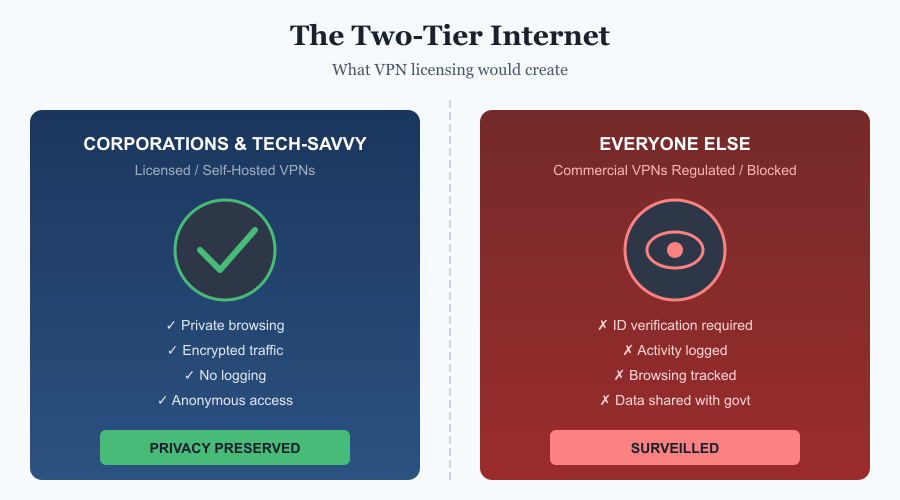
The result: a two-tier internet. Corporations and people with “legitimate business reasons” get some form of privacy. Everyone else that follows the rules gets surveilled.
We’re already seeing hints of this. The UK government isn’t calling for an outright ban, they’re talking about “registration” and putting VPNs “in scope” of regulation. That’s licensing language.
The Enforcement Problem
Here’s something legislators either don’t understand or are hoping you won’t notice:
these restrictions are nearly impossible to enforce against anyone willing to put in a little effort.
Some technical effort is required. Notice we didn’t say technical knowledge. Your favorite Gen AI tool will be able to walk you through how to implement this solution if you are determined enough.
Here’s how a workaround would work (not legal advice, of course).
