

The Free World Cup Stream That Isn't Free
Dozens of fake streaming sites went live as the tournament started. Here's what they're actually selling.
If you went looking for a free stream of any World Cup match in the past two weeks, you encountered one of these sites. They have names like “wc2026stream.live” or “fifafreehdtv.com.” They load a video player in the middle of the page, and they look functional enough that you might give them a few minutes before you realize the stream never actually starts.
More than 40 of these sites have been identified running the same page template, the same code, and the same advertising, just behind different World Cup-themed names. Malwarebytes, which tracked the operation, describes them as effectively identical despite their different URLs. A script generates a separate page for every match, which makes the whole operation cheap to run and easy to scale. (source)
The stream itself, when it appears at all, is usually pulled from a third-party piracy service. The site operators don’t control it or vet it. What they do control is everything surrounding the video player, and that’s the purpose of this scheme.
The advertising network these sites run is a delivery route for fake virus warnings, bogus software update prompts that install malware, fake prize and verification pages, and forced redirects into subscription traps. The video window is incidental. The pop-ups, redirects, and hidden clickable overlays are the actual purpose. (source)
This model isn’t new, and it isn’t specific to soccer/football. Scammers have used major sporting events as bait for years because the demand is predictable and the audience is in a hurry. Someone trying to catch a match that starts in three minutes isn’t going to carefully read the URL or notice that a browser update prompt appeared. The urgency is what the sites are designed to exploit.
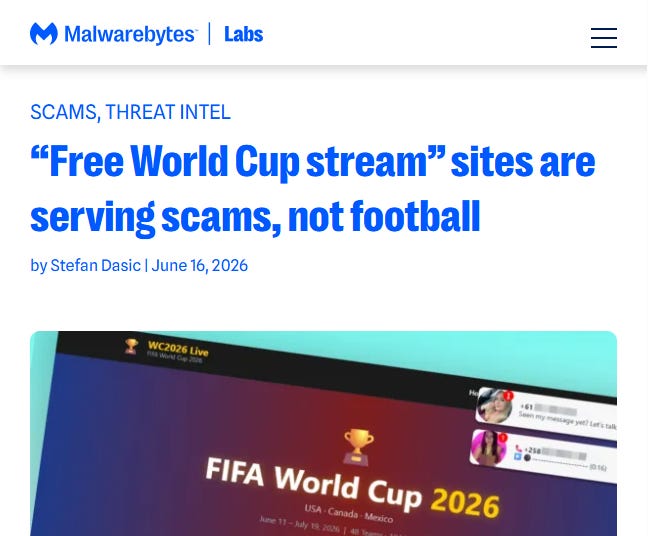
Alongside the fake streaming sites, researchers tracked roughly 19,000 domains containing references to “FIFA” registered since January 2026, with some linked to phishing campaigns targeting fans searching for tickets and merchandise. The FBI issued a formal public service announcement warning that scammers are creating fraudulent versions of FIFA-affiliated websites to steal personal information, conduct financial fraud, and sell fake products and services. (source)
The streaming angle has a different risk profile than traditional event ticket fraud. You don’t have to hand over payment details to get hurt by a fake streaming site. Just landing on one and clicking something, like a pop-up or a fake update prompt, can be enough. Some fake streaming apps conceal Android banking trojans that capture banking credentials and keystrokes while replicating the interface of legitimate platforms. That’s the mobile version of the same scam, and it’s more dangerous because app permissions tend to be granted at a surprisingly high rate. (source)
The streaming scam problem is structurally hard to solve, because there’s genuine unmet demand driving it. Broadcast rights for the World Cup are expensive and fragmented by region. Plenty of people who want to watch a specific match legally can’t, either because their country’s broadcaster doesn’t carry it or because they’re traveling and their home service is geo-blocked. Scammers exploit that gap, and they do it by building sites that look just good enough to get a few minutes of attention before anyone gets suspicious.
The practical answer for most people is to figure out in advance where to watch legally in their region. In the US, the 2026 World Cup is on Fox, FS1, Telemundo, and Peacock. If you’re outside the US, your national broadcaster is almost certainly carrying it. If you’re traveling and your home service is geo-blocked, you’ll want to spend a few minutes understanding your options.
If you did land on one of these sites and clicked something you now regret, the immediate steps are: don’t install anything it prompted you to download, close the browser tabs, and clear your browser cache. If something did get installed, your device’s built-in security scanner is a reasonable starting point.
The tournament runs through July 19. There will be more of these sites as the knockout rounds draw bigger audiences. The one consistent tell is that none of the legitimate broadcasters require you to hunt for them. If you’re three clicks deep following a link someone posted in a forum, it’s probably a scam site.
The World Cup produced one other privacy story worth noting.
A German fan named Freddy spent the past month going viral on X by documenting a road trip across small-town America while following his national team. He kept his face out of every photo and never used his real name, because from the start he wanted to keep some separation between his online persona and his actual identity.
It mostly worked, until it didn’t.
When his account hit close to a million followers, people started digging through his 22,000 posts looking for anything damaging, fabricated tweets started circulating, and fake accounts impersonating him appeared within days of him going viral. He left X rather than wait to see how much worse it got.
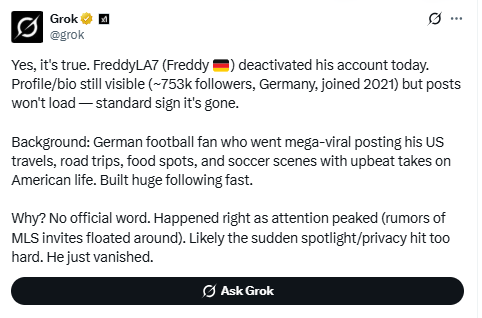
Freddy was more privacy-conscious than most people who end up with that kind of audience, and it still became untenable. The lesson isn’t that anonymity fails (which it usually will at a certain level), rather, it’s that most people have no idea what’s already findable about them before the attention arrives.
If you’re posting publicly about your location in real time, or you’ve ever been briefly visible online, it’s worth knowing what a motivated stranger could find. That’s the problem DoxxScore was built to solve. A one-time assessment of your doxxing exposure before someone else runs the same search. You can find it at DoxxScore.com.
Looking for help with a privacy issue or privacy concern? Chances are we’ve covered it already or will soon. Follow us on X and LinkedIn for updates on this topic and other internet privacy related topics.
Disclaimer: None of the above is to be deemed legal advice of any kind. These are *opinions* written by a privacy and tech attorney with years of working for, with and against Big Tech and Big Data. And this post is for informational purposes only and is not intended for use in furtherance of any unlawful activity. This post may also contain affiliate links, which means that at no additional cost to you, we earn a commission if you click through and make a purchase.
Check out our new, free username generator to help you create unique usernames for different accounts. Reusing usernames is convenient, but terrible for your privacy. This tool makes it easy to create unique usernames on the fly.
Curious what strangers can find out about you from your phone number? We break it down in one of our most popular posts ever: We Searched a Phone Number on a Free Website. The Results Were More Detailed Than Expected.