

Beyond Rights: The Mindset and Lifestyle That Make Privacy Real
Treat privacy rights as the floor, then use mindset and lifestyle to become a harder target
“Privacy is a right”.
If you follow privacy influencers on social media, you’re bound to see some variation of that quote. Sometimes it feels like it pops up multiple times a day (scroll here).

Human rights organizations even frame privacy as a natural right. Which means it is a fundamental entitlement that individuals possess by virtue of being human. In other words, governments and companies don’t give you privacy, they’re supposed to recognize and support it. Many countries have enshrined privacy rights into to formal law, including constitutions.
There’s just one problem:
rights are easily trampled on. Expecting Big Tech, government agencies, data brokers, and doxxers to respect your privacy because it’s a “right” is naive at best.
The reality is that you need to buttress those rights with some active self-help. Take privacy notices, for example.
Many privacy folks will tell you to carefully read privacy notices to find out how companies track and use your data and what you can do about it. This is an example of a “right”.
Sounds great in theory, but as someone who has worked on the inside, we take a contrarian POV. Reading website privacy notices is a waste of time. And relying on them is foolish.
Privacy notices are designed for one purpose: to give companies legal cover for their data collection practices. They are not there to protect you. If you’re worried about protecting your privacy, you won’t find salvation in a privacy notice.

What about GDPR? For those in the privacy space, GDPR is the gold standard for comprehensive privacy protections. Ask any privacy professional and they’ll tell you that.
The truth?
Calling GDPR “protection” rings hollow. It protects the appearance of choice more reliably than it protects people. It professionalized compliance teams, created a cottage industry of consent tooling, and gave platforms a playbook to keep the data flowing with new labels.
If you want actual protection, treat privacy “rights” like a floor, not a ceiling. Use the rights you do have, but don’t stop there.
Modifying behavior is important, and you do that through mindset and lifestyle. Mindset is how you decide in the moment. Lifestyle is the setup that makes safer the easy option. We’ll first explore mindset, then look at lifestyle.
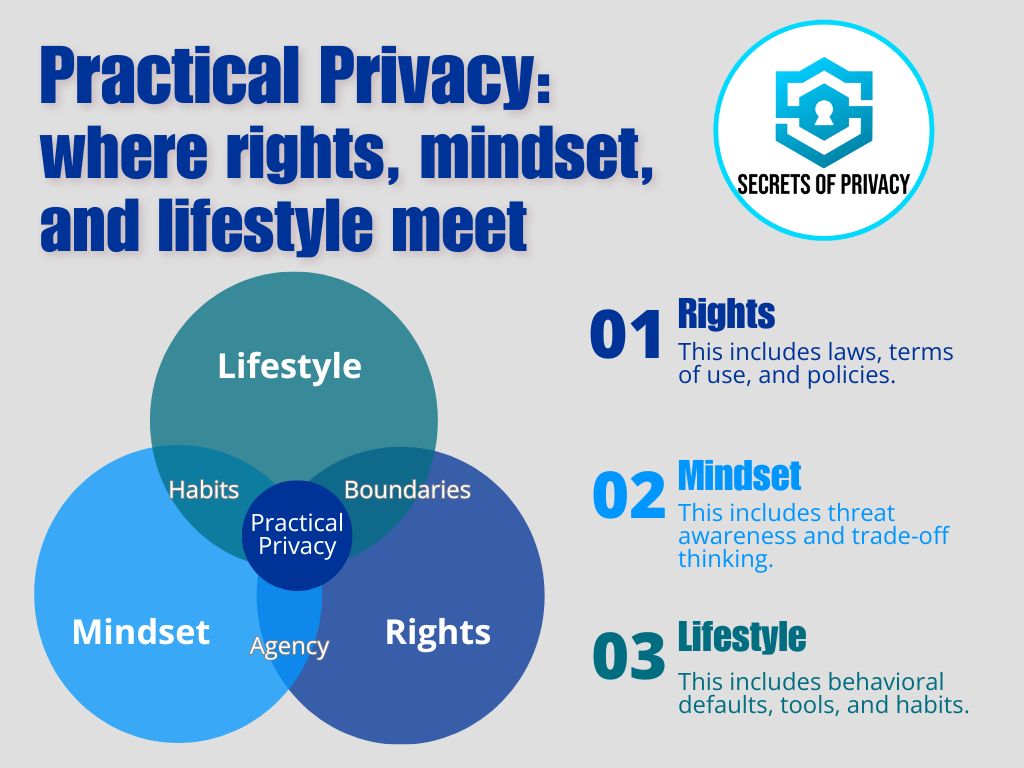
Mindset: Your Threat Radar
Mindset is a ten-second pause before you hand over anything you can’t easily take back.
Ask three questions:
What’s the give?
What’s the get?
Is there a lower-leak path?
A delivery app wants background location? The give is continuous tracking; the get is convenience. The lower-leak path is “only while using” and manual address entry. You still get dinner, but you don’t donate your movement history.
A site insists on your phone number “for security”? The give is a lifetime ID spammers and data brokers love; the get is a text code. Use an authenticator app or a secondary number you control. Same security, less exposure.
A sign-up flashes “Continue with Google/Apple”? The give is another tether to your central identity; the get is one-click convenience. Choose email + passkey. Thirty seconds now, less data gravity forever.
Those micro-choices are your habits, basically mindset in motion. Make them once; they get easier every time.
Lifestyle: Let The Setup Do The Work
Lifestyle is the quiet system that runs in the background. Keep your primary inbox for banking/health and route everything else through aliases so breaches hit the disposable alias, not your real, primary email address.
How do you do that? Here are some example scenarios:
Email Aliases. Keep your real inbox for banking, health, and a few trusted services. Everything else, like shopping, trials, newsletters (including ours), gets an alias. When a breach happens (and it will), the fire doesn’t jump into your primary life. You’re not reading policies; you’re avoiding the blast radius.

Put a password manager on your phone and laptop. Consider using passkeys or a hardware key for your most important accounts like email. That will kill a huge slice of phishing and credential stuffing. It’s boring, which is exactly why it works.
Upgrade your browser. Start using a privacy-respecting browser and search engine as defaults, add basic tracker blocking, and stop there. No 50-extension circus. You’re after quiet, not a hobby.
Trim location and camera leaks. Most apps don’t need precise location all the time. Flip them to “while using” or “never.” Strip location from photos by default. You don’t need a policy memo to do that; it’s one toggle and you’re done.
If you’ve leaned on “Sign in with Google/Apple/Facebook,” unwind one account at a time. Add email + passkey inside the app, confirm it works, then remove the social login. No heroics. Just one cord unplugged each week.

And we’re back to the original premise: privacy is a right. But rights only pay off when you pair them with a mindset that spots coercive “choices,” and a lifestyle that makes good behavior automatic.
Laws help at the margins. Your defaults and your micro-decisions change the game, and make you a harder target.
Friendly Ask
If you found this helpful or informative, chances are your friends and family will as well. Please share it with them to help spread awareness.
Looking for help with a privacy issue or privacy concern? Chances are we’ve covered it already or will soon. Follow us on X and LinkedIn for updates on this topic and other internet privacy related topics.
Disclaimer: None of the above is to be deemed legal advice of any kind. These are *opinions* written by a privacy and tech attorney with years of working for, with and against Big Tech and Big Data. And this post is for informational purposes only and is not intended for use in furtherance of any unlawful activity. This post may also contain affiliate links, which means that at no additional cost to you, we earn a commission if you click through and make a purchase.

Privacy freedom is more affordable than you think. We tackle the top Big Tech digital services and price out privacy friendly competitors here. The results may surprise you.
Do you own a Smart TV? If so, you won’t want to miss this post from our three part series on How To Make Your Smart TV Less Creepy.

If you’re reading this but haven’t yet signed up, join for free (3.7K+ subscribers strong) and get our newsletter delivered to your inbox by subscribing here 👇
I've switched this year to using the Brave browser; and I'm liking it.
Back in school, one of my professors used to say: “If you don’t pay for a service, you’re the product.”
And it’s so true. There are so many “free” services that use your personal information to make money. We should be careful about that. It is never a good idea to pay with your privacy!